How Developmental Stages Should Shape Parenting Plans
How Developmental Stages Should Shape Parenting Plans

Creating a parenting plan is one of the most significant challenges parents face during separation. While it is natural to focus on your own schedule or legal rights, research consistently shows that the most successful plans are child-focused and tailored to a child’s specific developmental stage.
Because children grow and change rapidly, a schedule that works for a toddler will likely be unsuitable for a teenager. Understanding your child’s age and corresponding stage of life allows parents to build security and support healthy brain development.
Key Principles for All Ages
Regardless of your child's age, certain core principles remain constant for their well-being:
- Conflict is Harmful: Children are significantly harmed when exposed to parental conflict, especially during transitions or exchanges.
- Stability is Security: Building security back into a child’s life immediately after a split is vital for their long-term health.
- Two Parents are Better Than One: Unless safety is at risk, children benefit most from the ongoing, meaningful involvement of both parents.
Developmental Stages & Scheduling Needs
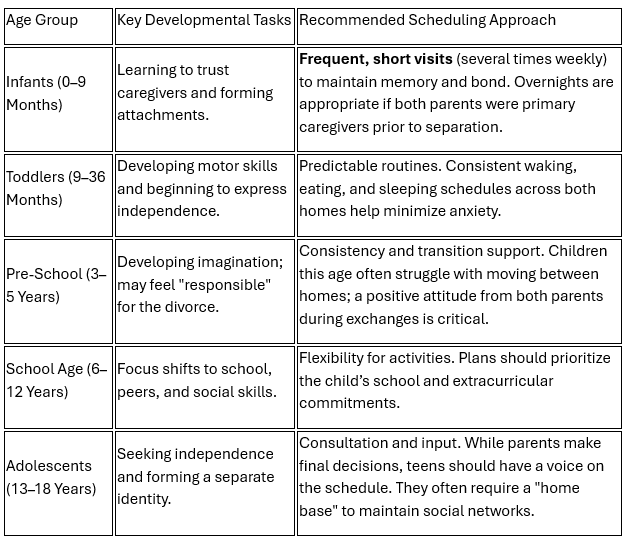
The following table summarizes how developmental tasks might influence your parenting time decisions:
Practical Tips for Successful Co-Parenting
When a child is non-verbal or very young, information sharing becomes the bridge between households.
- Maintain a Communication Log: For infants and toddlers, use a notebook to document feeding times, diaper changes, sleep duration, and any new developments.
- Prioritize the "First Port of Call: When a parent is unavailable during their scheduled time, consider offering the other parent the first opportunity to care for the child before calling a third-party sitter.
- Step-Up Plans: For parents re-establishing a relationship, use "step-up" plans that gradually increase time and overnights at a pace determined by the child's response.
- The "Transition Pack": Encourage children to carry "important" items like a favorite stuffed animal, blanket, or security toy between homes to provide continuity.
Assessing Your Readiness for Overnights
Before implementing overnight stays for children under three, consider the "pre-existing conditions" for success:
- Safety: Is the child safe and are the parents safe with each other?
- Relationship Quality: Has the parent been a consistent, comforting presence for at least six months?
- Responsiveness: Can the parent recognize and respond to the child's signs of stress or overload?
Special Considerations for Hawaii Families
In Hawaii, our community values play a significant role in how we resolve disputes. When shaping your plan, consider how the schedule affects the child’s relationship with extended family, including grandparents and siblings.
Finding Your Path Forward
Transitioning from a single household to two is a journey that requires patience, communication, and, above all, a commitment to your child’s emotional security. By aligning your parenting plan with your child’s developmental milestones, you are providing them with the stability they need to thrive during a time of significant change.
Remember that a successful parenting plan is not a "one and done" document. As your children grow, their needs will shift—and your plan should be flexible enough to grow with them. Whether you are navigating the frequent contact needs of an infant or the growing independence of a teenager, focusing on aloha and cooperation will always be in the best interest of your ohana.
We’re Here to Help
Navigating these changes can feel overwhelming, but you don’t have to do it alone. At Family Mediation Hawaii, we specialize in helping families create child-focused, sustainable agreements that keep you in control of your future.
Call us for more information or a free consultation at (808) 439-8600.